Updated March 27, 2026
A six-month survey of more than 1,100 LA wildfire survivors by United Policyholders found that 62% of total loss households lacked enough insurance to rebuild, and standing home survivors experienced claim problems at higher rates than total loss survivors. Common issues included communication delays, lowball settlement offers, and payment delays. Southern California homeowners can protect themselves by reviewing policy limits, understanding extended replacement cost and code upgrade coverage, documenting belongings, and consulting a licensed public adjuster before or after a loss.
 Jump to Frequently Asked Questions
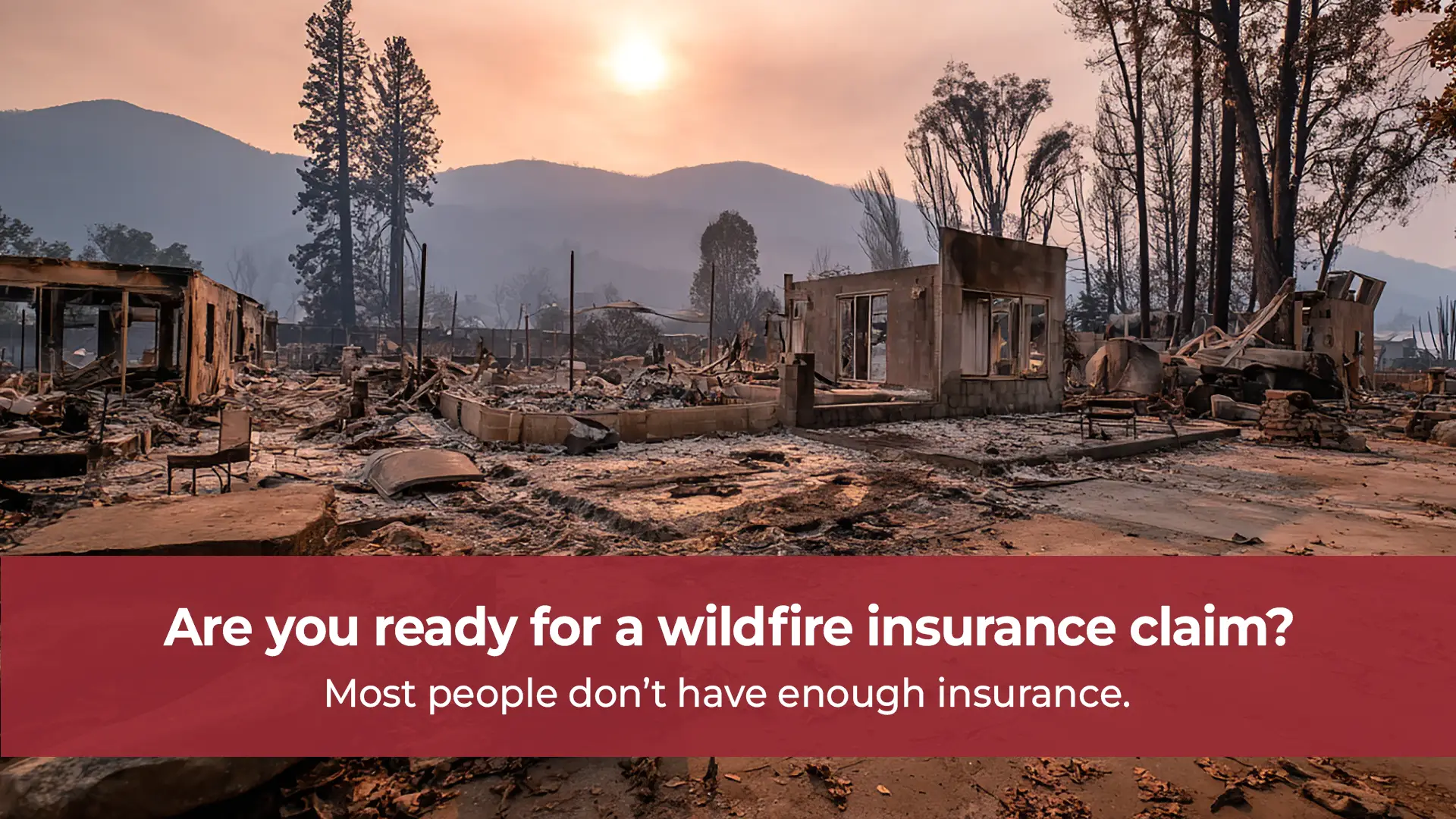
The January 2025 wildfires that tore through the Eaton and Palisades communities were among the most destructive in California history. More than a year later, thousands of families are still navigating insurance claims, temporary housing, and the long road to rebuilding, and thousands more are discovering too late that their insurance coverage falls far short of what it costs to rebuild. For Southern California homeowners whose homes were spared this time, the fires left behind something invaluable: a detailed, data-backed picture of exactly what goes wrong when disaster strikes and what you can do now to protect yourself. United Policyholders, a nonprofit consumer advocacy organization, surveyed 453 affected households representing more than 1,100 individual fire survivors six to eight months after the fires. The results are sobering.
Underinsurance after a wildfire: what the numbers reveal
Most people didn’t have enough insurance.
The single most alarming finding: 62% of total loss survivors reported they do not have enough insurance to cover the cost of rebuilding or replacing their home. Only 5% said they did. Perhaps more telling, a third of respondents said they simply don’t know yet, a number United Policyholders flagged as a likely indicator that the true underinsurance rate is even higher.
This is the nightmare scenario for any homeowner. You pay premiums for years, your home burns down, and then you discover your wildfire insurance coverage won’t cover what it costs to rebuild. It happens because replacement costs rise over time, driven by labor, materials, and updated building codes, while policy limits often stay flat.
The lesson for prepared homeowners is clear: Review your dwelling coverage limits now. Get an independent replacement cost estimate. Ask your insurer specifically about extended replacement cost (ERC) coverage and code upgrade coverage, two provisions that exist precisely to close this gap. Among survey respondents, 24% didn’t know how much code upgrade coverage they had, and 29% didn’t know their ERC percentage. Don’t be in that group.
Why smoke and partial damage claims are often harder to win
People with homes that were still standing had it harder than you’d expect.
Most wildfire coverage focuses on total loss. But the survey revealed something that often goes unnoticed: Homeowners with standing homes that suffered smoke or partial damage actually experienced claim problems at higher rates than those who lost everything. Just 3% of standing home survivors reported having no problems with their claim, compared to 27% of total loss survivors. Meanwhile, 86% of standing home respondents had not yet moved back into their homes months after the fires.
Smoke damage claims are complex. Contamination can be invisible and pervasive, remediation standards are contested, and insurers often push back harder on these claims precisely because the damage is harder to quantify. If you own a home in a wildfire-prone area, which in Southern California means most of us, understanding your smoke damage and loss of use coverage before a fire occurs is not optional.
How insurance companies handle wildfire claims and what to watch for
Insurers don’t make it easy.
The survey data on how insurance companies are handling claims is, unfortunately, not surprising. Among all respondents, 51% experienced delays in communication, 50% received what they considered a lowball settlement offer, and 49% reported payment delays. Nearly half had three or more insurance-company adjusters assigned to their claim at some point, and 29% said that when adjusters switched, they had to start the process over from scratch.
Understanding why insurance claims get denied, delayed, or underpaid and how to fight back is essential reading for any Southern California homeowner.
These are not freak occurrences. They are patterns that reflect a fundamental imbalance: Insurance companies have teams of professionals whose job is to manage claim costs. Most homeowners filing a fire damage insurance claim in Los Angeles by themselves have never been through anything like it.
How to prepare your homeowners’ insurance for a wildfire in Southern California
Here’s what you can do before the next fire.
The survey findings point to several concrete steps every Southern California homeowner should take now:
- Review your policy limits. Compare your dwelling coverage to current local rebuilding costs per square foot. If they don’t match, call your agent.
- Understand your ERC and code upgrade coverage. Know exactly what percentage of extended replacement cost you carry and whether it’s enough.
- Document your belongings. 57% of survey respondents were required to list and describe every single damaged or destroyed item. A home inventory video or photo log stored in the cloud takes an afternoon and saves enormous grief.
- Know your additional living expense (ALE) coverage. If you are displaced, ALE pays for temporary housing and related costs. Know your limits before you need them.
- Consider a public adjuster. A licensed public adjuster works for you, not the insurance company, to assess your damage, prepare your claim, and negotiate on your behalf.
How a public adjuster in Los Angeles can help
When a claim is straightforward and small, most homeowners can manage it themselves. But when a home is destroyed or severely damaged by a wildfire, the process becomes a full-time job involving documentation, negotiation, depreciation calculations, contractor estimates, and deadlines. That is exactly the situation most LA fire survivors found themselves in, and the survey makes clear that many felt overwhelmed and outmatched.
Metropolitan Adjustment Bureau, a licensed public adjuster who is a member of the National Association of Public Insurance Adjusters (NAPIA), has worked with Southern California homeowners through some of the region’s most devastating losses.
If you have been affected by the January fires and feel like you are falling behind, or if you simply want to understand your policy and your rights before the next disaster, we are here to help.
Contact us today for a free consultation.
Source: United Policyholders, 2025 Los Angeles Wildfires 6 Month Insurance and Recovery Survey Report. Data reflects responses from 453 households surveyed July through September 2025.
Frequently asked questions about wildfire insurance claims in Southern California
What does a public adjuster do for wildfire claims?
A public adjuster works exclusively for you, not the insurance company, to document your losses, prepare and submit your claim, and negotiate a settlement on your behalf. Unlike the adjuster your insurer assigns, a public adjuster’s job is to maximize your recovery, not minimize the payout.
How do I know if I am underinsured for a wildfire?
The clearest sign is a gap between your dwelling coverage limit and what it would actually cost to rebuild your home at today’s construction prices. Request an independent replacement cost estimate from a contractor or appraiser and compare it to your policy limit. If your policy hasn’t been updated in several years, there is a good chance the gap is significant.
What is extended replacement cost coverage, and do I need it?
Extended replacement cost (ERC) coverage adds a percentage on top of your dwelling limit (typically 20% to 50%) to help cover rebuilding costs that exceed your base policy limit. In a wildfire environment where construction costs spike sharply after a disaster, ERC coverage is one of the most important protections a Southern California homeowner can carry.
What is code upgrade coverage?
Also called ordinance or law coverage, code upgrade coverage pays for the additional cost of rebuilding to current building codes, which are often stricter than the codes in place when your home was originally built. Without it, you may be responsible for those extra costs out of pocket.
My home is still standing but has smoke damage. Am I covered?
Yes, smoke and partial damage are covered under most standard homeowners policies. However, these claims are frequently more contested than total loss claims. Insurers may dispute the extent of contamination or the cost of remediation. A public adjuster can be especially valuable in smoke damage situations where the harm is harder to see and quantify.
What should I do if my insurance company offers a settlement that seems too low?
Do not accept it without getting an independent assessment first. A lowball offer is one of the most commonly reported claim problems (half of LA wildfire survey respondents reported receiving one). You have the right to dispute the offer, request an appraisal, or hire a public adjuster to negotiate on your behalf.
How long does a wildfire insurance claim take to settle?
It varies widely. The United Policyholders survey found that six to eight months after the January 2025 LA fires, 51% of total loss survivors had still not settled the dwelling portion of their claim. Complex claims involving total loss, disputes over coverage limits, or smoke damage remediation can take a year or more.
How much does a public adjuster cost?
Public adjusters typically work on a contingency basis, meaning they collect a percentage of the final settlement rather than charging upfront fees. In California, the fee is regulated by the Department of Insurance. There is generally no cost to consult with a public adjuster about your claim before deciding whether to hire one.
Have more questions?
Please contact us. We’re happy to help.
This article is provided for informational purposes and does not constitute legal or financial advice. Insurance laws and regulations change frequently; consult with a licensed professional regarding your specific situation. Our firm is a licensed public insurance adjuster serving residential and commercial clients across Arizona, California, Colorado, Kentucky, Minnesota, Montana, Nevada, New Mexico, Oklahoma, Texas, and Utah.